Your home talks to you all the time.
Not with words, but with small signs most people ignore until the problem becomes expensive. Cracks, stains, noises, higher bills nothing happens by accident.
Signs your house needs siding replacement usually show up slowly, almost quietly. And that’s exactly why so many homeowners miss the right moment to act. When siding fails, it rarely announces itself loudly.
This article will help you read those signals with clarity. Not fear. Just awareness. So you can protect your home, your money, and your peace of mind before damage spreads where you can’t see it.
1. Cracks, warping, or visible deformation
If siding panels look bent, swollen, or cracked, that’s not cosmetic.
That’s structural stress.
Materials expand and contract, but siding is engineered to handle that. When it can’t anymore, it means age, moisture intrusion, or poor installation. Once panels warp, water finds paths behind them.
This is often the first visible warning and the cheapest moment to act.
2. Peeling paint or constant repainting
Repainting once in a while is normal.
Repainting often is a red flag.
When siding traps moisture or breaks down, paint becomes the messenger. Bubbling, peeling, or fading too fast usually means water is sitting where it shouldn’t. Paint doesn’t fail first it reacts to what’s happening underneath.
If this feels familiar, don’t just repaint. Investigate.
3. Higher energy bills without explanation
If your heating or cooling costs keep climbing, siding might be the silent culprit.
Damaged siding compromises insulation and air sealing.
Cold air sneaks in during winter. Heat invades in summer. Your HVAC works harder, longer, and costs more. This is one of the most overlooked signs your house needs siding replacement, because it doesn’t “look” like a siding issue.
But your utility bill never lies.
4. Mold, mildew, or stains on exterior walls
Dark streaks, green patches, or fuzzy growth are not just surface issues.
They’re symptoms of trapped moisture.
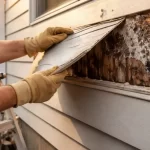
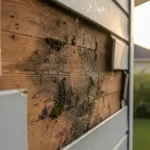
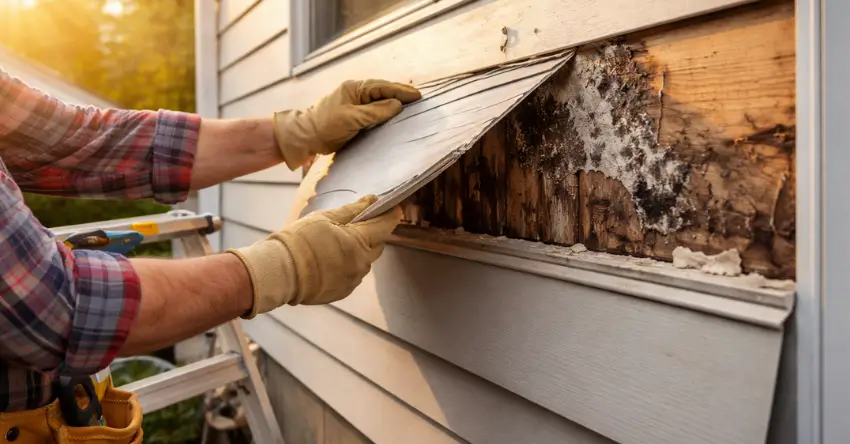
Siding should shed water, not absorb it. When moisture lingers, mold thrives and what you see outside may be much worse behind the panels. If this concerns you, you’ll want to explore Water damage behind siding: how to spot it to understand what could be happening out of sight.
This is about health, not aesthetics.
5. Rotting or soft spots
Press gently on suspicious areas.
If it feels soft, spongy, or weak, that’s decay.
Wood rot doesn’t stop on its own. It spreads. And once framing is affected, repair costs multiply fast. Siding’s job is protection. When it fails, your home’s skeleton is exposed.
At this stage, replacement is no longer optional it’s preventative surgery.
6. Frequent insect activity near walls
Termites, ants, and carpenter bees love compromised siding.
Cracks and moisture are invitations.
If insects keep showing up along exterior walls, don’t just call pest control. Ask why they’re comfortable there. Often, the real issue is deteriorating siding giving them access and shelter.
Fixing the surface without fixing the structure never works long-term.
7. Interior wall damage with no plumbing issues
Stains, bubbling paint, or peeling wallpaper inside the house especially near exterior walls are major warning signs.
If plumbing is ruled out, siding is the next suspect. Water travels. By the time it appears indoors, it has already passed through layers meant to protect you.
This is one of the clearest indicators that replacement is overdue.
8. Faded, outdated, or uneven appearance
This isn’t about trends.
It’s about performance.
Severely faded siding often means UV damage has weakened the material. Uneven color can signal moisture saturation in certain areas. Beyond curb appeal, these visual cues point to aging systems losing integrity.
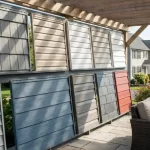
If you’re already questioning durability, it’s time to compare materials like in Vinyl siding vs fiber cement: which lasts longer in Connecticut? to understand long-term value.
9. Loose or missing panels after storms
Strong winds don’t remove healthy siding.
They expose weak siding.
If panels loosen, rattle, or fall off after storms, the fastening system or material has failed. Temporary fixes won’t restore original protection. Every storm after that increases risk.
This is your home telling you it’s tired.
10. Your home is over 20–30 years old
Age alone doesn’t mean failure but it raises the odds.
Older siding systems weren’t designed for today’s climate stress or efficiency standards.
Even if problems aren’t obvious yet, proactive replacement often costs less than reactive repairs. Especially when moisture damage hasn’t reached framing.
Sometimes the smartest move is acting before the crisis.
Your home protects your life, your family, your memories.
When siding starts failing, it’s not just a construction issue it’s a trust issue.
Ignoring the signs doesn’t make them disappear. It just postpones the cost and increases the risk. Awareness gives you control. Timing gives you options.
If this article sparked questions, that’s a good thing. Keep exploring the blog. Learn how siding materials differ, how water damage hides, and how smart exterior decisions save money long-term.
Your house is speaking now you know how to listen.